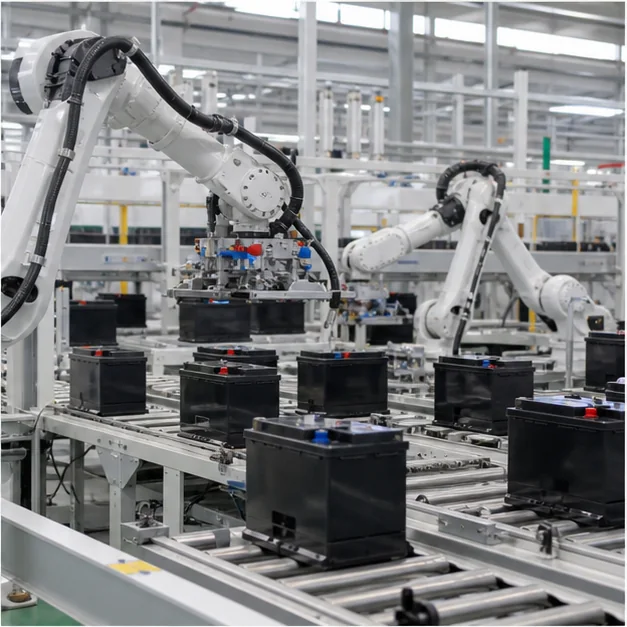
Modern start-stop systems place a fundamentally different load profile on a 12V lead-acid battery compared to conventional vehicles. The alternator is frequently disengaged during coasting and idling, forcing the battery to supply all electrical loads and then accept a rapid recharge. This repeated micro-cycling demands a battery with higher charge acceptance, deeper cyclic durability, and better resistance to acid stratification than a standard flooded battery.
For international importers and fleet buyers, the procurement decision is not simply "AGM vs EFB." It is a question of matching battery architecture to vehicle type, regional driving patterns, and total cost of ownership. This guide provides a technical comparison of AGM (Absorbent Glass Mat) and EFB (Enhanced Flooded Battery) technologies, with specific guidance on sourcing from a China automotive battery manufacturer and navigating export logistics.
Technical Fundamentals: AGM and EFB Construction
AGM: The High-Performance Standard
AGM batteries use a microfiber glass mat that is saturated with sulfuric acid. The mat acts as both the separator and the electrolyte reservoir. Because the electrolyte is immobilized, there is no free liquid to stratify (separate into layers of different acid density). This is a critical advantage in start-stop applications where partial state-of-charge (PSOC) operation is common.
Key construction features of AGM batteries:
- Recombination efficiency: Oxygen generated at the positive plate diffuses through the glass mat and recombines with hydrogen at the negative plate, reducing water loss. Typical recombination efficiency is above 99% in a well-sealed unit.
- Low internal resistance: The tight plate stack and thin glass mat reduce the distance between plates, lowering internal resistance. This enables higher charge acceptance—typically 20–40% higher than a comparable flooded battery.
- Valve-regulated design: AGM batteries are sealed with a pressure relief valve. They are classified as "valve-regulated lead-acid" (VRLA) and can be mounted in various orientations (though inverted mounting is not recommended).
- Cycle life: Under standardized start-stop testing (e.g., EN 50342-6), a quality AGM battery can deliver 200,000–300,000 engine starts. However, actual field performance depends on temperature, alternator control strategy, and parasitic loads.
EFB: The Cost-Effective Evolution of Flooded Technology
EFB batteries are an improved version of the conventional flooded battery. They retain liquid electrolyte but incorporate design enhancements to handle the demands of entry-level start-stop systems.
Key construction features of EFB batteries:
- Enhanced positive plate: The positive grid uses a lead-calcium-tin alloy with a denser, thicker structure compared to standard SLI (starting, lighting, ignition) batteries. This improves corrosion resistance under cyclic operation.
- Polyester scrim or fleece: A thin non-woven layer is applied over the positive plate surface. This holds active material in place, reducing shedding (the loss of active mass due to expansion and contraction during cycling).
- Carbon additives: Some EFB designs add carbon to the negative active material to improve charge acceptance and reduce sulfation during PSOC operation.
- Acid stratification control: While EFB cannot fully prevent stratification, the scrim and optimized grid design slow the process. Some designs use a slight acid circulation mechanism.
EFB batteries typically support 60,000–120,000 starts in the same EN 50342-6 test. They are approximately 30–50% less expensive than AGM units of equivalent capacity, making them the default choice for entry-level and mid-range vehicles with basic start-stop functionality.
Comparative Performance and Application Fit
The table below summarizes key technical parameters. Values are indicative ranges based on typical OEM specifications; always confirm exact figures with the manufacturer's datasheet.
| Parameter | AGM (Typical Range) | EFB (Typical Range) | Notes |
|---|---|---|---|
| Nominal voltage | 12V | 12V | Both conform to automotive 12V systems |
| Capacity (C20) | 60–105 Ah | 60–95 Ah | Higher capacity available in AGM for luxury vehicles |
| Cold Cranking Amps (CCA, EN) | 680–950 A | 600–850 A | CCA depends on plate count and surface area |
| Cycle life (EN 50342-6 starts) | 200,000–300,000 | 60,000–120,000 | Lab test; field life varies with temperature and SOC |
| Charge acceptance (at 25°C, 80% SOC) | 0.8–1.2 A/Ah | 0.5–0.8 A/Ah | Higher in AGM due to lower internal resistance |
| Internal resistance (fully charged) | 2.5–4.5 mΩ (for 70Ah) | 4.0–6.5 mΩ (for 70Ah) | Lower resistance improves cranking and recharge |
| Water loss | Negligible (sealed) | Low but not zero | EFB may require periodic electrolyte check in hot climates |
| Operating temperature range | -40°C to +60°C | -40°C to +55°C | AGM handles higher under-hood temperatures better |
| Mounting orientation | Any (except inverted) | Upright only | EFB contains free liquid electrolyte |
| Typical vehicle segment | Premium, luxury, high-option vehicles | Entry/mid-range start-stop vehicles | Also used in some commercial applications |
When to Specify AGM
AGM is the correct choice when:
- The vehicle has regenerative braking (recuperation) that charges the battery at high rates.
- The vehicle has multiple auxiliary loads (heated seats, electric steering, infotainment) that draw significant current during engine-off phases.
- The vehicle is equipped with advanced start-stop logic that allows long engine-off periods (e.g., coasting with the engine off).
- The battery is located in the passenger compartment or trunk, where gas recombination is essential for safety.
- The operating environment involves frequent short trips in cold climates, where PSOC operation is common.
When to Specify EFB
EFB is the pragmatic choice when:
- The vehicle has basic start-stop without regenerative braking.
- The vehicle is a fleet vehicle with predictable duty cycles and moderate electrical loads.
- The buyer prioritizes lower upfront cost and acceptable cycle life for the application.
- The battery is mounted in the engine compartment with adequate ventilation.
- The climate is moderate, reducing the risk of thermal runaway and water loss.
A common mistake is fitting an EFB to a vehicle originally designed for AGM. The alternator control logic in such vehicles may demand charge rates that exceed EFB's capability, leading to premature failure. Conversely, fitting AGM to a basic start-stop vehicle is safe but economically suboptimal.
Sourcing from a Chinese OEM Factory: Manufacturing Controls and Export Logistics
Buyers should audit the Chinese factory's manufacturing route from lead-alloy control and plate casting through curing, assembly, formation, capacity testing and final inspection. Plate casting parameters, grid alloy records and lot traceability should be included in the supplier quality plan. For export logistics, confirm the battery design and current carrier requirements before assigning UN2800 for qualifying non-spillable batteries or UN2794 for wet batteries; sea freight documentation, packaging and test evidence must match the actual product.
When sourcing AGM or EFB batteries from China, the buyer must verify that the factory's manufacturing processes align with the technology being purchased. The production line for AGM and EFB differs significantly, and a factory that produces one type does not automatically excel at the other.
Plate Casting and Grid Alloy Control
The grid is the backbone of any lead-acid battery. In a Chinese OEM factory, the grid casting process is typically performed on continuous or book-mold casting machines. Key parameters to verify:
- Alloy composition: Lead-calcium-tin alloys are standard for both AGM and EFB. The tin content (typically 1.0–2.5% by weight) affects corrosion resistance and interphase conductivity. A reputable factory will provide a spectrometric analysis certificate for each batch.
- Grid weight tolerance: A well-controlled process maintains grid weight within ±2% of the design target. Heavier grids are more corrosion-resistant but reduce the active material ratio; lighter grids may fail prematurely.
- Casting temperature and cooling rate: These affect grain structure. A fine, uniform grain structure resists intergranular corrosion. Ask the factory for their casting temperature profile and cooling method (air vs. water quench).
Plate Curing and Formation
After pasting, the plates must be cured (hydrothermal treatment) to develop the basic lead sulfate structure. Curing parameters (temperature, humidity, time) are critical for adhesion between the paste and grid. In AGM production, the separator wrapping and acid filling are done under controlled pressure to ensure proper compression. For EFB, the scrim application and acid filling are equally critical.
A serious Chinese manufacturer will have:
- In-line X-ray or ultrasonic inspection for plate integrity.
- Automated acid filling with precise volume control (for EFB) or vacuum filling (for AGM).
- Formation charging in temperature-controlled tanks or chambers, with individual cell voltage monitoring.
Production QC and Testing
Before shipment, a factory should perform the following tests on a sampling basis (typically per IEC 60095 or EN 50342 standards):
- Capacity test (C20): Discharge at 0.05C to 10.5V at 25°C.
- Cold cranking test: Discharge at the rated CCA for 10 seconds, then check voltage (must be ≥7.5V for most standards).
- Charge acceptance test: Measure current at 14.4V after a defined discharge.
- Water loss test (for EFB): Measure weight loss after overcharge.
- Vibration resistance: Per ISO 12405 or similar, especially for AGM used in commercial vehicles.
Request the factory's inspection report (e.g., a third-party pre-shipment inspection from SGS, Bureau Veritas, or TÜV) to verify these tests. Do not rely solely on the factory's self-declared QC.
Export Logistics: UN Numbers and Sea Freight Documentation
The classification of lead-acid batteries for transport is not a single rule. The correct UN number depends on the battery type and its test status.
- UN2794 applies to filled, wet batteries (electrolyte is free liquid). This includes most EFB batteries and conventional flooded batteries. They are classified as Class 8 (corrosive) dangerous goods.
- UN2800 applies to batteries, wet, non-spillable that pass the vibration and pressure differential tests specified in Special Provision 238 of the UN Model Regulations. AGM batteries and other VRLA types typically qualify for UN2800. They are not subject to the full dangerous goods regulations if they pass the test and are marked as "non-spillable."
Critical distinction: An EFB battery cannot be shipped as UN2800 unless it is specifically designed and tested as non-spillable (which is rare for EFB). Conversely, an AGM battery that has not passed the vibration test cannot be shipped as UN2800. Always confirm the current rule with your freight forwarder or the competent authority, as regulations are updated periodically.
For sea freight, the following documentation is typically required:
- Dangerous Goods Declaration (DGD) for UN2794 shipments.
- Material Safety Data Sheet (MSDS) from the manufacturer.
- Certificate of Origin (for tariff purposes).
- Packing List and Commercial Invoice with correct HS codes (e.g., 8507.10 for lead-acid electric accumulators).
A reliable Chinese supplier will provide the MSDS and test certificates. However, the shipper of record (usually the exporter) is legally responsible for correct classification. As an importer, you should verify the UN number on the Bill of Lading matches the battery type.
RFQ Data and Sourcing Decisions
When requesting a quote from a Chinese factory, provide the following data to ensure accurate pricing and lead times:
- Battery type (AGM or EFB) and the specific vehicle application (make/model/year).
- Electrical specifications: Voltage, capacity (Ah), CCA (EN or SAE), and dimensions (L×W×H, including terminal type).
- Target cycle life (e.g., 200,000 starts for AGM) and any OEM-specific test requirements.
- Packaging requirements: Individual cartons, palletization, and any markings (e.g., "non-spillable" for UN2800).
- Incoterms (e.g., FOB Shanghai, CIF Rotterdam) and preferred port of discharge.
Tradeoffs to consider:
- Minimum order quantity (MOQ): Chinese factories often have MOQs of 500–1,000 units for custom specifications. Standard models may be available in smaller quantities from trading companies, but at a higher unit cost.
- Lead time: Typical production lead time is 25–40 days after sample approval. Sea freight from Shanghai to Rotterdam or Los Angeles adds 25–35 days.
- Payment terms: Common terms are 30% T/T deposit and 70% against the Bill of Lading copy. Letters of credit (L/C) are accepted by larger factories.
For a deeper look at related product lines, you can review the Chinese supplier's motorcycle battery range or their solar storage battery solutions, which often share the same plate manufacturing technology.
Installation and Maintenance Considerations for Buyers
For fleet buyers and system integrators, the installation environment matters as much as the battery chemistry.
AGM Installation Notes
- Charging voltage: AGM batteries require a charging voltage of 14.4–14.8V (at 25°C) for bulk charging, with a float voltage of 13.5–13.8V. Using a charger designed for flooded batteries (which may exceed 15V) will cause gassing and premature failure.
- Temperature compensation: The charging voltage must be reduced by approximately 0.03V/°C above 25°C and increased below 25°C. Many modern vehicles handle this automatically, but aftermarket chargers may not.
- Replacement: When replacing a battery in a vehicle with a smart charging system, the battery management system (BMS) may need to be reset. This is a dealer-level procedure.
EFB Installation Notes
- Ventilation: EFB batteries release small amounts of hydrogen and oxygen during charging. Ensure the battery compartment has adequate venting to the outside.
- Acid level checks: In hot climates, check electrolyte levels every 6–12 months. Some EFB designs have a magic eye indicator, but this only shows the state of one cell.
- Retrofit caution: An EFB can replace a standard flooded battery in a non-start-stop vehicle, but it will not provide any benefit unless the vehicle's charging system is compatible.