Choosing between AGM and colloidal GEL batteries for solar installations is not a matter of brand preference—it is a technical and financial decision that affects system uptime, replacement frequency, and total cost of ownership over a 10–15 year project horizon. For international importers and EPC contractors sourcing from China, the differences in cycle life, depth of discharge (DOD) tolerance, and manufacturing consistency directly impact warranty claims and customer satisfaction. This guide compares both chemistries from a procurement perspective, explains what to verify in a Chinese factory, and clarifies the logistics documentation that governs sea freight of these batteries.
Understanding the Electrochemical Difference: AGM vs Colloidal GEL
The fundamental distinction lies in how the electrolyte is immobilized. AGM (Absorbent Glass Mat) batteries use a microporous glass fiber separator that absorbs the sulfuric acid electrolyte, holding it in a dry-like state. Colloidal GEL batteries, by contrast, mix the electrolyte with fumed silica to form a thixotropic gel that solidifies after filling. This simple difference drives divergent behavior in solar duty cycles.
AGM: High Rate, Moderate Cycle Life
AGM batteries excel in applications requiring high discharge currents, such as hybrid inverters with surge loads or backup systems with frequent but shallow cycling. The low internal resistance (typically 2–4 mΩ for a 100 Ah unit) allows efficient charge acceptance. However, the thin separators and compressed plate design make AGM more sensitive to deep discharges. At 80% DOD, most AGM products from tier-2 Chinese factories rate 300–500 cycles; premium brands may reach 600 cycles, but this often requires a controlled charge profile that solar charge controllers may not deliver.
Colloidal GEL: Deep Cycle Endurance
Colloidal GEL batteries are engineered for deep cycling. The silica gel immobilizes the electrolyte, preventing acid stratification—a phenomenon where acid concentration becomes higher at the bottom of the cell, accelerating grid corrosion. This allows GEL batteries to operate at 80% DOD with 600–1,200 cycles, depending on plate thickness and alloy composition. The tradeoff is higher internal resistance (5–8 mΩ for 100 Ah), which reduces peak discharge capability but is rarely a constraint in solar PV systems where loads are typically steady-state.
Key procurement insight: For off-grid solar systems with daily cycling to 60–80% DOD, colloidal GEL batteries often provide a lower cost-per-cycle despite a higher upfront price. For grid-tied backup systems with infrequent discharges, AGM may be more economical.
Life Cycle and DOD: A Quantitative Comparison
The table below summarizes typical performance parameters for 12V 100Ah batteries from mid-tier Chinese manufacturers. Values are indicative ranges, not guarantees—always request the factory's cycle life curve for your specific charge voltage and temperature.
| Parameter | AGM (12V 100Ah) | Colloidal GEL (12V 100Ah) | Notes |
|---|---|---|---|
| Cycle life at 50% DOD | 800–1,200 cycles | 1,200–1,800 cycles | Tested at 25°C, 0.1C discharge |
| Cycle life at 80% DOD | 300–500 cycles | 600–1,200 cycles | Higher DOD accelerates grid corrosion |
| Max DOD (continuous) | 50–60% recommended | 70–80% recommended | Exceeding reduces life non-linearly |
| Charge efficiency | 90–95% | 85–92% | GEL has slightly higher internal resistance |
| Self-discharge rate | 2–3% per month | 1–2% per month | At 20°C, after full charge |
| Operating temperature | -20°C to +50°C | -20°C to +55°C | GEL tolerates higher ambient heat |
| Internal resistance | 2–4 mΩ | 5–8 mΩ | Measured at 1 kHz, fully charged |
| Typical float voltage | 13.5–13.8V | 13.6–13.9V | Confirm with factory datasheet |
| Typical cycle voltage | 14.4–14.8V | 14.2–14.6V | GEL requires lower absorption voltage |
Interpreting the data: The cycle life advantage of GEL at high DOD is the primary reason solar EPCs in regions with limited sunshine (e.g., Northern Europe, high-latitude areas) prefer GEL. However, in tropical climates where ambient temperatures exceed 35°C, AGM's lower internal resistance reduces heat generation during charging, which can offset some of GEL's cycle advantage. Always request cycle life data at your project's average temperature, not just at 25°C.
Manufacturing and QC Considerations When Sourcing from a Chinese Factory
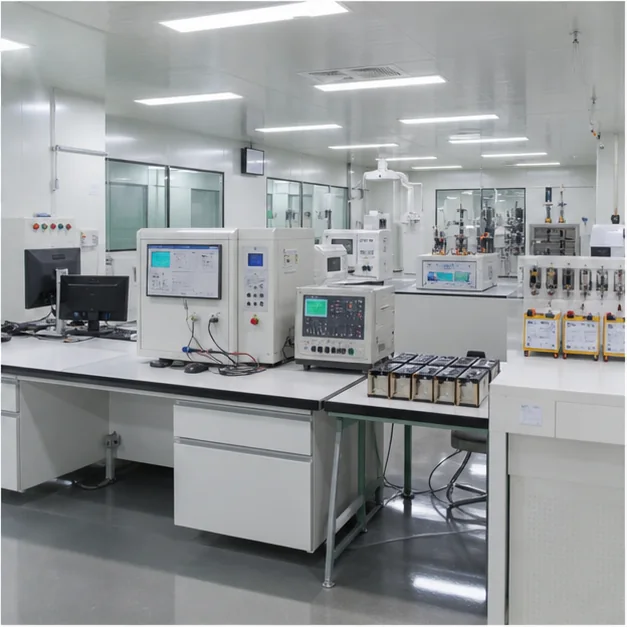
Buyers should audit the Chinese factory's manufacturing route from lead-alloy control and plate casting through curing, assembly, formation, capacity testing and final inspection. Plate casting parameters, grid alloy records and lot traceability should be included in the supplier quality plan. For export logistics, confirm the battery design and current carrier requirements before assigning UN2800 for qualifying non-spillable batteries or UN2794 for wet batteries; sea freight documentation, packaging and test evidence must match the actual product.
Compare specifications with this Chinese OEM factory battery range before issuing the RFQ.
When evaluating a China solar gel battery manufacturer, the factory's process control determines whether you receive a 600-cycle or a 1,200-cycle product. Here is what to inspect during a factory audit or via documented evidence.
Lead-Alloy and Plate Casting Controls
Chinese factories typically use lead-calcium-tin alloys for positive grids and lead-calcium for negative grids. The critical parameter is grid thickness uniformity. Reputable manufacturers use gravity casting with automated mold temperature control (±5°C) and X-ray fluorescence (XRF) analysis to verify alloy composition. Ask for the factory's grid thickness tolerance—a ±0.1 mm tolerance is standard for quality producers; ±0.2 mm indicates older equipment.
Verification step: Request a copy of the alloy certificate for each production batch. The tin content in positive grids should be 1.2–1.8% for GEL batteries to prevent passivation at deep discharge. Some factories use continuous casting (Concast) for negative grids, which improves consistency but requires higher capital investment.
Plate Curing and Formation
The curing process (hydration of lead oxide paste) and formation (initial electrochemical charge) are where many Chinese factories cut corners. Proper curing at 60–70°C and 95% relative humidity for 24–48 hours is essential for plate adhesion. Formation should be conducted at controlled current density (typically 5–10 mA/cm²) over 18–24 hours. Ask for the factory's formation protocol and whether they use a two-step formation (which improves capacity consistency).
Production QC and Testing
A reliable factory will have:
- Automated welding of plate groups (cast-on-strap, or COS) with pull-test verification at 50–80 N per cell.
- 100% leak testing of each battery after electrolyte filling, using helium mass spectrometry or pressure decay methods.
- Sample capacity testing per batch (typically 1–2 units per 100) at 0.1C to 10.5V, with results logged and traceable.
- Charge acceptance testing at 14.4V for AGM or 14.2V for GEL, measuring current at 10 minutes and 60 minutes.
Red flag: If a factory cannot provide batch-level test reports with date stamps and operator signatures, treat their cycle life claims as marketing, not engineering data.
Export Logistics: UN2800 vs UN2794 and Sea Freight Documentation
A common sourcing error is assuming all lead-acid batteries ship under the same UN number. This is incorrect and can cause customs delays or carrier refusal.
UN2800: Batteries, Wet, Non-Spillable
UN2800 applies to sealed lead-acid batteries that pass the vibration and pressure differential tests specified in the UN Manual of Tests and Criteria (Section 38.3). Both AGM and colloidal GEL batteries typically qualify as non-spillable if they pass these tests. The advantage of UN2800 classification is that batteries are exempt from most dangerous goods regulations when packed in strong outer packaging and protected against short circuits. However, carriers may still require a declaration and may impose stowage restrictions.
UN2794: Batteries, Wet, Filled with Acid
UN2794 applies to wet, non-sealed lead-acid batteries (e.g., flooded types) that can spill electrolyte. This classification requires full dangerous goods documentation, including a Shipper's Declaration for Dangerous Goods, UN specification packaging, and compatibility with the vessel's dangerous goods stowage plan. Do not assume your AGM or GEL battery is UN2794—verify the factory's test certificate.
Sea Freight Documentation Checklist
For a typical 20-foot container of solar batteries from China:
- MSDS (Material Safety Data Sheet) — Must reference the specific UN number and transport class.
- UN38.3 Test Summary — For lithium batteries only; lead-acid requires Section 38.3 vibration and pressure tests, but the summary format differs.
- Dangerous Goods Declaration — Required for UN2794; optional but recommended for UN2800.
- Certificate of Origin — For tariff preference, if applicable.
- Packing List — Must state the number of batteries, total weight, and UN number per battery.
Action item: Before finalizing a purchase order, request the factory's current UN2800 test certificate (valid for 3 years) and confirm with your freight forwarder that the carrier accepts non-spillable lead-acid batteries under their specific terms. Some carriers require a "Battery Transport Document" even for UN2800.
Sourcing Decision Framework for Importers and EPCs
When comparing quotes from Chinese suppliers, use a weighted scoring model rather than unit price alone.
Cost-Per-Cycle Calculation
For a solar system cycling daily to 70% DOD:
- AGM: 400 cycles × 70 Ah usable = 28,000 Ah total throughput. At $85 per battery (example), cost = $0.0030/Ah.
- GEL: 900 cycles × 70 Ah usable = 63,000 Ah total throughput. At $110 per battery (example), cost = $0.0017/Ah.
The GEL battery is 44% cheaper per Ah of delivered energy, despite a 29% higher upfront cost. This calculation should drive your procurement decision for daily-cycling solar systems.
RFQ Data Requirements
When requesting quotes from Chinese factories, specify:
- Cycle life at 50%, 70%, and 80% DOD, tested at 25°C and 35°C.
- Grid thickness and alloy composition (request XRF report).
- Formation protocol (voltage steps and duration).
- UN2800 test certificate validity and issuing laboratory.
- Warranty terms tied to DOD—some factories prorate warranty if DOD exceeds 60%.
Factory Audit Focus
If visiting a factory, prioritize:
- Plate casting area: Check for automated temperature control and alloy composition monitoring.
- Formation room: Verify that formation racks are connected to a central monitoring system, not manual timers.
- QC lab: Confirm the presence of a cycle life tester (e.g., Bitrode or Digatron) and request to see recent test curves.
For a deeper dive into battery selection for specific solar configurations, review our solar storage product line and compare specifications across AGM and GEL models.