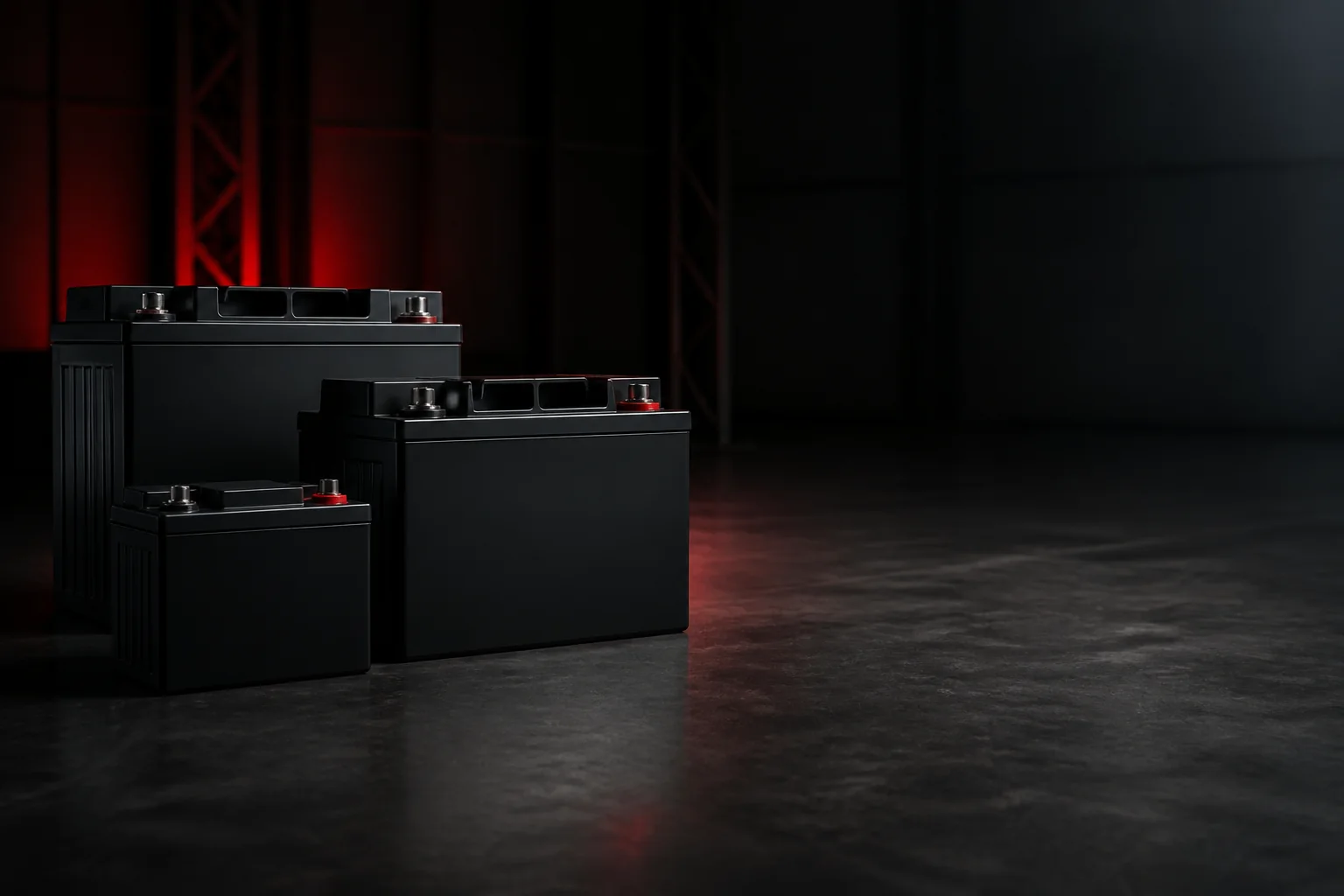
Direct answer: YTX4L-BS serves small commuter motorcycles, YTX9-BS covers higher-output street and sport applications, and 6MFZ12 targets larger motorcycles and utility three-wheelers. A reliable cross-reference must confirm dimensions, terminal orientation, activation state and model-specific test data—not only the printed model code.
For distributors in Latin America, Africa, the Middle East and Southeast Asia, these three formats frequently appear in replacement catalogues and mixed-container enquiries. They are not interchangeable simply because all are 12 V batteries.
Use the table below as an RFQ starting point. Final production values must be locked in an approved datasheet and pre-production sample because capacity, CCA, case design and terminal layout can vary by brand programme and market specification.
TECHNICAL CROSS-REFERENCE
YTX4L-BS vs YTX9-BS vs 6MFZ12 specifications
The values below are common procurement targets for sealed motorcycle starter battery programmes. Buyers should request the final factory drawing and test standard for every quoted model.
| OEM model | Voltage | Capacity (10HR) | CCA target (-18°C) | Dimensions (L×W×H) | Typical application |
|---|---|---|---|---|---|
| YTX4L-BS | 12 V | 3.0–4.0 Ah | 55 A | 113 × 70 × 85 mm | Small commuter motorcycles and scooters; confirm polarity and terminal position. |
| YTX9-BS | 12 V | 8.0–9.0 Ah | 135 A | 150 × 87 × 105 mm | Street, sport and mid-displacement motorcycles requiring higher starting output. |
| 6MFZ12 | 12 V | 12.0 Ah | 160 A | 150 × 87 × 130 mm | Larger motorcycles, cargo tricycles and utility applications; verify the 12N12 cross-reference. |
CCA values are procurement targets, not universal ratings. Confirm the test method, temperature, activation state and acceptance tolerance in the purchase specification.
MODEL SELECTION
What each model means for a wholesale programme
YTX4L-BS: fast-moving commuter fitment
Prioritise case accuracy, left/right terminal orientation and consistent activation instructions. It is usually a volume model, so carton strength and batch traceability have a direct effect on claims.
YTX9-BS: higher starting performance
Ask for the CCA test method, plate design and vibration control. Confirm whether the offer is factory-activated, dry with an acid pack, AGM or GEL because handling and shipment terms change.
6MFZ12: utility and three-wheel demand
Do not assume every 6MFZ12 equals a 12N12 case. Approve the terminal drawing, hold-down features, venting or sealed construction, and the exact application list before printing private-label cartons.
SEA-FREIGHT COMPLIANCE
UN2800 and IMDG Special Provision 238: what importers should verify
UN2800 is the shipping entry for wet, non-spillable electric storage batteries and appears as a Class 8 entry in the IMDG Dangerous Goods List. A sealed label alone does not prove that a battery meets the non-spillable transport conditions.
For sea freight, ask for evidence specific to the exact model and construction. Where the conditions of IMDG Special Provision 238 are met—including the applicable vibration and pressure-differential tests—the shipment may qualify for relief from other provisions of the Code, subject to correct protection, packing, documentation and carrier acceptance.
Important: IATA Special Provision A67 is an air-transport provision; it should not be presented as the legal basis for an ocean shipment. Sea bookings should reference the applicable IMDG requirements and the carrier’s current acceptance rules.
PRIVATE LABEL & CONTAINER PLANNING
Build the RFQ around the approved model, not a generic battery name
A comparison-ready factory quotation should state the same technical and commercial fields for every model. That makes suppliers easier to evaluate and prevents a low unit price from hiding a lower capacity or weaker packing specification.
- Required quantity by model, annual forecast and whether mixed-container loading is needed.
- Case colour, label artwork, master-carton language and barcode requirements.
- Capacity, CCA test method, terminal layout, battery activation state and warranty target.
- Destination port, requested Incoterm and the model-specific transport documents required by the forwarder.
- Pre-shipment inspection plan covering dimensions, open-circuit voltage, capacity or CCA sampling, packaging and loading photos.
FACTORY-DIRECT RFQ
Request a model-by-model wholesale quotation
Send the quantities for YTX4L-BS, YTX9-BS and 6MFZ12, your destination port and any private-label requirements. We will confirm the available construction, MOQ, lead time, packing plan and supporting shipment files.
BUYER QUESTIONS
Frequently asked sourcing questions
Are YTX4L-BS and YTX9-BS interchangeable?
No. They differ in case dimensions, capacity and starting output. Confirm the application, terminal orientation and hold-down arrangement before selecting either model.
Is 6MFZ12 always the same as 12N12?
Not always. The codes may be used as cross-references in some catalogues, but case height, terminal layout, venting and performance can differ. Approve the factory drawing and sample before ordering.
Does UN2800 automatically make the shipment non-dangerous?
No. UN2800 is a Class 8 shipping entry. Relief under IMDG Special Provision 238 depends on the exact battery meeting the required conditions, correct packing and short-circuit protection, supporting evidence and carrier acceptance.
What should be included in a wholesale motorcycle battery RFQ?
List the model, quantity, destination market and port, chemistry or activation state, CCA and capacity targets, terminal layout, private-label requirements, warranty expectation and required transport documents.
Can YTX4L-BS, YTX9-BS and 6MFZ12 be loaded in one container?
Mixed-model loading can be planned when the per-model MOQ, carton dimensions, pallet plan and weight distribution are confirmed. Ask the supplier for a model-level packing list before approving the order.